Good product survey questions ask one thing at a time, in plain language. The fifteen below cover satisfaction, usability, pricing, missing features and churn risk, and each is phrased so the answer tells you what to do rather than how the customer feels about being asked.
If your product is doing well, the metrics should show it: usage up, churn down, more retained customers, rising MRR. When the numbers are mixed, product survey questions tell you why.
Product surveys are one of the most useful ways of validating if your company is growing with the product in mind.
Surveys collect customer feedback from many customers at once. Write the survey questions so they don’t push people toward an answer, and the results will hold up when someone checks them.
Write from the customer’s side. Most people answer short, simple questions and drop out when the questions get long. Keep each one neutral, easy to understand and different from the last.
What is a Product Survey?
A product survey is a set of questions businesses use to learn how users think about their product. It shows where the product stands in the market and whether it’s on the right track.
With a product survey, businesses can obtain feedback and understand their customers’ needs and wants.
A product feedback survey conducted before the product launch helps in the formation of new ideas and design, how to price the product, the placement order, and more, and may give you valuable insights into what your target audience wants and need.
Note: Product surveys are not limited to existing products, and they can be run before the development of the product, before product launch, and after product launches.
This gives you a clue about how it is received, its performance, what is missing, and more.
And Why Should I Run a Product Survey?
1. Measure customer satisfaction
If you want to know how many customers are satisfied with your products, a product survey is what you need. It is an effective way to know what they like, dislike, want, and need and see areas for improvement.
For example, you can use product evaluation survey questions to determine their evaluation rates and satisfaction levels.
2. Better Understand your users
Product surveys give you access to real data and save you from making assumptions about your users. With a product feedback survey with the help of feedback widgets, you will know how they think and feel, their buying patterns, what they prefer to buy, and more. This, in a way, makes you feel close to your most loyal customers.
3. Spot friction in the product
Questions about setup, daily use and support show where people get stuck, so the team knows which part of the product to fix first.
4. Track change over time
Asking the same questions every quarter shows whether a release made things better or worse.
Why is it important to ask good survey questions?
Writing good survey questions is the hardest part of running a survey.
If the questions are poorly phrased or put together, the responses will be useless.
However, developing good product research survey questions is central to gauge participants’ attitudes effectively.
If the survey product questions are well-written, they will make sense to the respondents, and you will get relevant and honest feedback.
15 Best Product Survey Questions Examples To Ask
These are the fifteen product survey questions we have found most useful, drawn from running product feedback collection ourselves. Each one is short enough to answer in a sentence and specific enough to act on:
- What do you like about our product?
- What do you dislike about our product?
- Which features did we miss?
- What can be improved?
- What kinds of things would you like to stay the same for future generations of the product?
- How likely are you to recommend this product?
- What do you need our product to do for you?
- How straightforward is our product?
- How does our product compare to others you’ve tried?
- Why did you choose our product?
- How straightforward is our website?
- If you couldn’t choose our product, which alternative would you choose and why?
- What recommendations do you have for future generations of this product?
- What do you value most in our product?
- Do you think our product is worthwhile, and why?
If ever in doubt, here are some of the top customer satisfaction survey questions to try too.
For hands-on practice, start a Usersnap free trial (no credit card needed) or use one of our ready-made survey templates.
New Product Survey Questions Examples
Launching something new? These questions tell you how customers and users see it.
New Product Survey Questions samples:
- What’s your initial impression of our new product? (Scale: Negative – Positive)
- How likely are you to try our new product? (Scale: Unlikely – Very Likely)
- What features of our new product interest you the most? [Open-ended]
- Are there any features missing in our new product that you expected? [Open-ended]
- How well does our new product solve a problem you currently face? (Scale: Not Well – Very Well)
- Would you prefer our new product over similar products in the market? (Yes/No)
- What could we do to make our new product more appealing to you? [Open-ended]
- On a scale of 1 to 10, how clear is the value proposition of our new product?
- How user-friendly do you find our new product’s interface? (Scale: Not User-Friendly – Very User-Friendly)
- Are there any improvements or changes you’d suggest for our new product? [Open-ended]
Tell respondents what their answers will change. People answer more carefully when they know the input shapes the product.
Product Survey Questionnaire Templates and Samples
Some questions you can use as a template or copy/paste them to your questionnaire.
- How satisfied are you with the overall quality of our product? (Scale: 1-10)
- Have you encountered any issues or defects with our product? (Yes/No)
- Does our product meet your needs or expectations? (Scale: Not Well – Very Well)
- How reliable is our product in your day-to-day work? (Scale: 1-10)
- Does our product work well with the tools you already use? (Yes/No)
- How often do you face problems using our product? (Scale: Rarely – Often)
- On a scale of Unlikely to Very Likely, how probable are you to recommend our product based on its quality?
- What do you find most impressive about our product’s quality? [Open-ended]
- Where do you think our product’s quality could be improved? [Open-ended]
- Rate how easy it was to get started with the product. (Scale: 1-10)
- Compared to similar products, our product’s quality is? (Scale: Worse – Better)
- Have you experienced any performance issues with our product? (Yes/No)
For more survey templates
For additional survey questionnaire templates, check out Usersnap’s collection and feel free to customize them according to your needs:
How to Write a Good Feedback Survey (by yourself)
Every survey depends on its goals, but these steps work for most.
1. Set your goals
Start by deciding what the survey should achieve.
This is the first step to writing successful survey questions: define what your main goals and objectives are.
By setting clear objectives, you can easily stay on track while determining which questions you want to ask the most. This way, you can leave out unnecessary questions that do not align with your desired results.
Take our example, before we come up with product research survey questions or product usage survey questions, we align on a hypothesis. What is the cause of the problem? What are the expectation or prediction?
When the new navigation was launched on Usersnap, our hypothesis was that new users would be able to set up projects easily. And we ran a customer effort score (CES) survey to validate the ease of use, as well as some specific questions about functionality and sentiment.
If your hypothesis is not crystal clear, don’t worry, you can start with some open-ended questions so that all voices and answers are welcomed.
2. Go for specific questions
The importance of asking specific product questions is two-fold.
Firstly, it helps you focus on the key topics which makes the requested information more actionable.
Secondly, it allows you audience to grasp the scenario and purpose of your questions, so that they can zoom in on the exact information and provide answers faster.
Here’s an example of the survey questions to ask about a new product.
We would use this to understand new users and their preferences of the educational content we should serve.
3. Use simple language
Survey questions should be simple and easy to understand to everyone who takes it. Your audience should be able to quickly read each question and know exactly what it is asking. Avoid not only complex words but also technical language.
4. Don’t lead the respondent
When asking questions, be sure to ask them in a way that doesn’t influence a biased response. For example, rather than asking, “Why do you love this product?” you may write, “What is your honest opinion on this product?”
If creating a feedback survey, you will want the most accurate response you can get. By avoiding leading words, you can precisely know what the client thinks about the products rather than being swayed one way or another.
Benefits of Product Surveys
“The main reason products fail is because they don’t meet customer needs in a way that is better than other alternatives.”Dan Olsen
Here’s what product surveys give you.
Getting user insights, quickly and easily
Utilizing product surveys allows you to get detailed feedback on issues that your customers find important.
Surveys are one of the cheapest ways to hear from customers directly.
From there, you can make the appropriate changes to make your product or service even more valuable.

If the respondents are your ideal customers, you also learn what they buy and why.
Learning consumer behavior and buying habits is an essential piece of information for re-launching a current product or presenting them with a new one.
A product feedback tool handles the collection and the first pass of analysis, so you spend your time on what the answers mean.
In practice, the most effective teams do more than collect responses. They use a dedicated feedback collection tool to spot patterns, prioritize issues, and close the loop with customers faster.
Also Read: What are customer insights? Definition and examples
Decision making
After you get responses to your surveys, you will have personalized statistics for your company and products or services.
Rather than throwing a product or service out and seeing how it does, you will already have an idea of how well it will do based on responses.
You and your group will be able to make more knowledgeable selections based on what your ideal client wants or needs.
When you find yourself struggling to determine what to launch next, all you will need is to take a look over the survey results and you will have your answer.
Improving user experience and satisfaction
Product surveys are a key method to improving user experience because you will know exactly what they are looking for.
By asking customers questions about your next product roadmap, they can feel like their voices matter.
If the product falls short, people want a way to say so. A short questionnaire gives them one, and it shows you want to hear it.
A follow-up survey also catches unhappy customers early, while there’s still time to fix the problem for them.
Ideas for Creating Product Feedback Survey Questions
Here are our tips. For a general checklist, see this guide to writing surveys.
1. Ask open-ended questions
Product surveys should include open-ended product or website feedback questions to allow customers to respond in detail. In this way, product managers can better understand the customer’s perspective and true feelings.
Unlike closed-ended questions, open-ended questions provide more information. When you want to hear specific concerns or praise for a particular product, these kinds of questions will be more helpful.
You can also use product questionnaires that allow a customer to choose from a set group of answers.
Having response options can help customers who aren’t the best at articulating their needs. These kinds of questions are sometimes more helpful than vague, open-ended questions, especially if they direct your customers towards a specific concern.
Mix both types. Use closed questions for numbers you can track and open questions for the reasons behind them.
2. Keep it precise
The best customer feedback questions to ask are relevant and precise to the product.
Reflect to your original goals when crafting survey questions to ask about a product. You will want to also ensure that your questions are not redundant or repetitive.
Consider what you’d like to know about your product to develop some good survey examples. Does your product have flaws? Does it have unexpected benefits? How has your product made your customer’s life better or worse?
You can also compare your current product to others, such as previous renditions or versions.
In short, keep it small and keep it moving.
3. Let ‘em know what they get out of this
Realistically, people do not get overjoyed to see a new survey to fill out. To get the most respondents, let them know what is in it for them if they answer the questions.
For example, you can mention that their answers will contribute to better products or services in the future. Or if they aren’t so thrilled with that response, you can offer incentives as well.
People also tend to offer assistance when they clearly understand why any individual is asking for their help. If you explain that you want to ensure your product is great or find a way to improve it, customers will be more likely to help you out.
Customers who rely on your product are especially willing to help when they know the goal is to make it better for them.
4. Take partial responses seriously
Sometimes, respondents will get partially through the survey before quitting. Even if the survey isn’t complete, there may be vital information within the filled answers.
In short, do not throw half responses away.
As you create your product remarks survey, ensure that the issuer or software program will keep track of any partial responses.
You can still gain valuable insights and knowledge from the parts filled out and may see a pattern and choose to update your survey.
5. Ask for feedback from customers after product survey questions
Getting customers to leave some additional feedback can provide a lot of extra information.
When requesting feedback after the customer satisfaction survey, ensure that the subject line is well thought out to grab their attention.
Asking for feedback from customers after the survey isn’t necessary every time. However, adding this small detail can allow you to improve and make adjustments for the future.
Product Managers: Using Insights to Innovate Products
Product managers who work from customer data make better decisions and build better software.
Insights for a compassionate product manager
“Product people. It’s not your job to have all the answers. It’s your job to ask the best questions. There’s nothing more dangerous than a product person who thinks they have all the answers!” Janna Bastow
To build the right product, you have to understand the people using it. That understanding is also where the useful insights come from.
Product managers will do their best work if they can find a middle ground between the business side and the consumer side. Gathering market research, survey ideas, and getting to know the customer helps to validate product decisions.
Using questions to ask customers about your product, you can learn about flaws you might have missed.
The risk is dismissing feedback because the product seems obvious to you. If you understand it, surely they do too?
Unfortunately, not everyone who receives your product will see it the way you do.
Actually, it’s more likely that your customer will approach it completely differently from how you might expect. But, being compassionate towards their opinions can help you gather useful insights to improve your product.
Your customers will reach out to you, no doubt about it.
Whether you sent a survey or they’re simply pleased or annoyed, be ready for it.
Make it easy for them to reach you, for example through the Usersnap feedback button on the side of the page, then listen and show them what changed. What customers say decides whether a SaaS product keeps its users.
The Value of Customer Interviews and Product Survey Questions
Customer interviews and survey questions give you people’s unfiltered views, positive and negative.
Such in-depth and unfiltered data provides the relevant and important information needed to improve products and services.
Good Customer Interview Questions to Ask:
- Broadly speaking, what do you think of our product?
- How satisfied are you with our product generally? Why? Could you quantify your thoughts on a 1-10 scale?
- If a colleague asked about our product, how would you speak about it to them. Why?
- How would you describe your usage of our product?
- Could you state how you feel when using our product?
- Could you mention what you precisely like about our product? And dislike?
- What would be the one improvement area of our product that would help you when using it?
- Why did you choose us as a product or tool for hire?
- On a scale of 1 to 10, how satisfied are you with our customer service?
How metrics and analytics shape product development
Using various metrics to analyze the development or success of your product can help you understand which step to take next. By looking at statistics from your product surveys, you can learn what ideas people liked and what they didn’t like.
Their first reactions help you decide which elements to keep and which to drop. Sometimes they send you back to rethink how you present the product.
Product evaluation survey questions can give you proper measurements to determine the projected success of your product. However, you can also use other metrics to help influence new product development.
Survey results are one input. Usage, conversion and churn data tell you whether what people say matches what they do.
Conclusion: drive predictive thinking for product manager innovation
Customer needs follow patterns, and a little research shows you where they’re heading.
A survey on a new product shows product managers how customers behave, so they can build what those customers need.
Put yourself in the customer’s position and ask which questions would tell you the most about their experience.
When customers see their needs met release after release, they stay. Knowing what they like and dislike shows the product team where to go next.
What happens to the answers once they come in?
Fifteen good questions will get you a few hundred responses. Whether that turns into a decision depends entirely on what happens between the response landing and someone reading it.
Responses arrive in one list rather than a spreadsheet export. Sentiment Sensor reads each one as it lands and tags it with a topic and a sentiment, so a week of answers arrives already sorted into themes. Your team turns the themes that keep recurring into opportunities on the Opportunities Board and scores them on value and effort, so prioritization starts from how often something was said rather than who says it loudest. From there the Hypothesis Generator drafts what to test next, based on the responses you collected rather than the model’s general knowledge. Sentiment Sensor and the Hypothesis Generator are included on Professional plans and above, and available as add-ons on Starter and Growth.
Every one of those outputs keeps a link back to the response behind it. When someone asks why a survey finding made the roadmap, you open the theme and read the original answers underneath, which is the difference between a number in a deck and a claim that survives a follow-up question. Keeping that line unbroken is what makes Usersnap a product evidence platform.
Surveys are one source of that evidence, not the whole picture. The same workspace holds in-app feedback, bug reports and, with Channels (included from the Growth plan), support conversations and call transcripts, so a survey theme sits next to what customers said everywhere else. In an enterprise with several product teams, that cross-checking happens in one place instead of in someone’s spreadsheet.
FAQs For Product Survey Questions
Here are some common questions on the subject, and our answers.
What are 5 types of product survey questions?
Five types of survey questions are open-ended questions, multiple-choice questions, ordinal scale questions, interval scale questions, and ratio scale questions. Each type of survey question for a new product serves a unique purpose for a product manager and depends on the overall goal and questions asked.
How do you survey a product?
To survey a product, you must first set clear goals for the survey. Then, you craft questions that lead to information pertaining to a goal. Use the survey responses to collect feedback, tally the results and create statistics. These statistics and market research are useful for future product innovation.
What sort of product survey questions should I ask?
There are many questions you can ask a customer about a product, depending on what your overall goals are. Suggested questions you should seek answers for include how often the customer uses the product, ease of use, important features they need, and the problem the customer is trying to solve by using said product.
What does a product survey include?
A product survey includes a variety of product evaluation questions with the intent of gathering feedback. Utilizing product surveys allow product managers to use data from the customers for further innovation.
What is an example of a product research question?
What features or improvements would encourage you to choose our product over competitors in the market?
This question helps gather insights into what specific aspects of your product potential customers consider important and what would make your product stand out to them compared to similar options available in the market.
What are the questions on the product quality survey?
- How satisfied are you with our product’s overall quality? (Scale: 1-10)
- Have you experienced any issues or defects with our product? (Yes/No)
- Does our product meet your needs? (Scale: Not Well – Very Well)
- Rate the reliability of our product. (Scale: 1-10)
- Does it work with your other tools? (Yes/No)
- How often do you face problems using our product? (Scale: Rarely – Often)
- Would you recommend our product based on quality? (Scale: Unlikely – Very Likely)
- Strongest aspect of our product’s quality? [Open-ended]
- Areas for product quality improvement? [Open-ended]
- Ease of getting started? (Scale: 1-10)
- Compared to similar products, our quality is? (Scale: Worse – Better)
- Encountered performance issues? (Yes/No)
These shorter questions still cover the key aspects of product quality and user satisfaction.
FAQs
What are good survey questions for a product? Good product survey questions ask one thing at a time, in plain language, and can be answered in a sentence. The ones that earn their place cover overall satisfaction, how easy the product is to use, which feature the person relies on most, what is missing, what nearly made them stop using it, and whether the price matches the value they get. Avoid double-barrelled questions and anything that signals the answer you are hoping for.
What is a product survey? A product survey is a set of questions that helps you understand how people feel about your product, what they enjoy, what bothers them, and how simple it is to use. Companies rely on these surveys to collect honest opinions, try out new ideas, fix issues, and make smarter choices about future steps.
Why are product survey questions important? Strong survey questions reveal what your customers want, how satisfied they are, and where they’re facing challenges. They highlight what’s going well and what needs improvement, so you’re not left guessing. This feedback helps you build better products, adjust your marketing, and keep your customers coming back.
What should you include in a product survey? Start with the essentials, so overall satisfaction, ease of use, which features people are using, and any difficulties they face. You can also add questions about how your product compares to others. Be sure to include open-ended questions, since the most valuable feedback can come from people sharing their thoughts in their own words. Using both ratings and written responses gives you both the data and the story behind it.
How do you create an effective product survey? Begin by knowing exactly what you want to find out. Choose the right audience, and keep your survey short and straightforward so people don’t quit halfway through. Make sure your questions are clear and unbiased. Test out the survey before sending it to more people. When you get the answers, dig into the data and use the feedback to make meaningful improvements.
How does Usersnap help with product surveys? Usersnap is a product evidence platform. It collects survey answers through customizable micro-surveys and in-product widgets, alongside screenshots and screen recordings. It automatically captures metadata such as browser and OS, enriches responses with screenshots or recordings, and integrates with tools like Jira and Slack to centralize insights and accelerate product improvement.
Trust what AI tells you about your customers
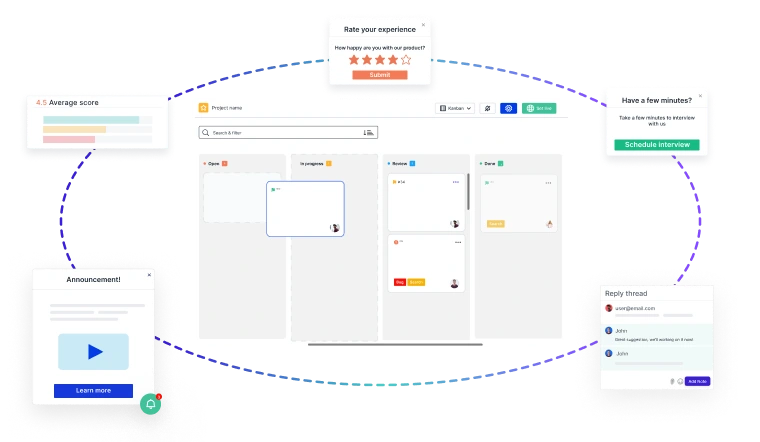
Most product teams have been burned by an AI summary nobody could trace back to a real customer. Usersnap scopes every AI output to the evidence actually collected in your workspace, so each insight, hypothesis and sentiment score links back to the comment that produced it.
- Open the source behind any claim, instead of guessing what the model assumed.
- Keep your data yours. Customer data is never used to train AI models, and AI features can be switched off per account.
- Stay inside the EU. GDPR compliant, hosted on AWS in Frankfurt and Ireland.
Put it against your own feedback before you commit. Start free or book a demo with our team.
