Product-market fit (PMF) means your product meets a real market need so well that customers would be very disappointed to lose it. A product-market fit template is a ready-made survey that measures this, usually with the Sean Ellis question: “How would you feel if you could no longer use this product?”
Think of product-market fit (PMF) as sailing: the product is the sail and demand is the wind. For the boat to work or to make your dreams come true, you need to build a sail (product) and find the wind to power it (or satisfy the needs of the market, and its potential customers). If you are a good sailor, you can always feel when the product-market fit is or isn’t happening. The best way to sail the SaaSy seas is to have a product-market fit template on your side.
Imagine the following scenario:
Eureka! You’ve got the most fantastic product idea of your career. Everyone is going to love it. Your team spent countless hours nailing down every detail. You’ve had many sleepless nights trying to figure out what you might have missed. You’re confident that you have thought of everything. Your gut is telling you that this will be a huge success, and that your emergence as a product-led growth leader in your business will surely come.
Unfortunately, your product idea generates very little enthusiasm. You might be wondering what you did wrong. Did you ask yourself first how successfully you’ve identified your target customers and if you are serving them the right product?
If you don’t have the answer from the customer feedback, then the next best move is to use a product-market fit template. If you’ve never heard of PMF, you can check out Usersnap and try the product-market fit (PMF) survey template before scaling your next incredible product.
What is a product-market fit template really about?
Product-market fit is less about hypothetical numbers and percentages (that you can get from holistic market research), and more about in-depth and tangible understanding of who your customers are, and how they feel about you and your product.
At Usersnap, we tested our own product-market fit as we grew, and we learned how much a simple, well-timed survey helps. Usersnap is a product evidence platform that connects what people say, what you build, and how it lands.
For that reason, we created several product feedback templates to help you get insights across the entire product lifecycle, including PMF.
By the end of this article, you’ll:
- Get a brief overview of PMF, and how it came to be
- Have a measuring system to determine whether you have reached product-market fit,
- Different questions you can use in your product-market fit survey template.*
*With Usersnap, you can customize your PMF surveys, show them to the right users at the right moment, and send the answers to the tools your team already works in.
Let’s get started!
💡 A short history of product-market fit 💡
Product-market fit was originally coined by Marc Andreessen in his article The Only Thing That Matters. He described it, very broadly, as “being in a good market with a product that can satisfy that market”.
Product-market fit is not a new concept. Many have built on this concept. In the mid-nineties, Andy Rachleff, the co-founder of Benchmark Capital and Wealthfront, used product-market fit to describe business development’s three most important aspects.
- What is your product?
- Who is your target audience?
- How are you going to get your product to the right market?
Notably, Eric Ries in The Lean Startup talked about finding the viral engine of growth through a build-measure-learn feedback loop and established the concept of Minimum Viable Products (MVPs).
This was subsequently brought to life by Dan Olsen in the Lean Product Playbook and many have subsequently cited the steps he proposes.
 Source
Lenny Rachitsky, Silicon Valley PM veteran and author of the brilliant influential Lenny’s newsletter, has also suggested that “Nothing matters more than retention. But, there are other indicators you should pay attention to along the way.”
He proposes the following important components based on canvasing a range of expert opinions:
- Make a product that people want
- Make a profit delivering this product to people at scale
- Find and keep these people, sustainably
 Source
GrowthHackers’ Sean Ellis is generally considered the reference point for how to measure product-market fit in user satisfaction terms.
The ‘40% rule’ proposes that if 40% or more people answer “very disappointed” to the question “How would you feel if you could no longer use our product?” then you (probably) have product-market fit. Although some have contended that this is the best way to validate it, not to help you find it.
Get more information on the history of PMF here. At the end, you’ll find some of the most influential articles on the topic.
How to measure PMF with a product-market fit template?
Now that you know what product-market fit is, you need to know how to measure your product-market fit. Or, as Aristotle put it: We cannot change the wind. But we can adjust the sails.

Many KPIs can indicate product-market fit, but nothing gives you clearer answers than asking your customers directly. Surveys are the most direct way to find out whether you have product-market fit, and Usersnap lets you target them to the right customers.
Usersnap’s platform has several features designed to show you how to measure product-market fit. For example, Usersnap’s poll and statistics can shed quantitative insights, other features are for getting qualitative insights to identify what and why there is or is not product-market fit.
Feedback button and menu
The most direct way to gather data is a dedicated feedback button that opens your feedback forms. Users can offer suggestions, and a feedback menu (switched on by request) can guide them to the right support or feedback option.
Capture videos and screenshots
Users can draw or pin comments on their screens with the in-app widget.
Surveys
Create various types of a survey based on client events, URL pathway, or amount of time on a page. Usersnap offers product-market fit questions and poll templates to make this a breeze. These customer satisfaction survey templates surveys can be followed up by qualitative product-market fit questions that will inform your marketing strategies.
Omnichannel opportunities
Usersnap collects feedback across channels and devices, including an inline rater you can use in emails and a full-page collector you can share as a link.
Request upvote board
This feature allows users to see and vote on their suggestions. Clients are kept informed about the progress of the company.
Labels, statistics, and reply-to
Organize all relevant feedback with a split-screen view. You can quickly study the data and use it to inform your decisions.
Survey Questions to Measure with your Product-Market Fit Template
Startups need to invest the time to determine their determine product-market fit in market, and they need to determine if there is a significant demand for their product or service. Companies might think they have a great product, but they will fail if the market doesn’t support it.
How Would You Feel If You Could No Longer Use Our Product?
Sean Ellis, the CEO, and co-founder of Growthhackers, believes this is the best question to determine product-market-fit. In this scenario, success correlates to 40% of respondents disappointed if they could no longer use your product. This is also the question that we use for our template at Usersnap (see above).
What Type Of People Do You Think Would Most Benefit From Our Product?
You have to figure out who your target customers are. The next step is to create a buyer persona, put yourself in your customers’ shoes and figure out what they want.
The marketing team (thinking as the ideal customer) must figure out what they want. What:
- features do they use the most often?
- is your budget?
- will make this product a must-have?
Usersnap makes this easier by gathering the data that informs your marketing strategy, which also helps you target similar customers with effective campaigns.
How Can We Improve Our Product For You?
Customer feedback is essential at every step of development. They are the people that will be using the product, so their advice should be taken to heart. Sometimes, companies become too invested in their products, and they don’t want to see any weaknesses.
People that are shelling out money for the product will be able to point out weaknesses. But, this is a good thing, and it allows companies to make changes that will meet their customers’ demands.
Gathering information about what they liked, what they didn’t like, what needed improvement, and if they felt anything was missing is essential to launching a successful product. Studying the data will allow you to see trends where improvement or change is needed.
What Is The Main Benefit You Receive From Our Product?
Nowadays, people are looking for easy, fast, and affordable. Customers are looking to satisfy their needs without any fuss. If your product promises to do something, it should do it.
When you first identified a need in the market, your product should have been designed to answer that need. Customers should recognize that benefit, or you have missed your mark.
If customers are happy with the product, you will benefit from an added advertisement by word of mouth from satisfied customers.
How Did You Discover Our Product?
Knowing where people learned about your product will show you how well your marketing campaign works. Knowing how your customers find you is crucial for amping up your advertisement in that area and making changes in other areas.
What Would You Likely Use As An Alternative If Our Product Were No Longer Available?
Having a good PMF score doesn’t mean your work is done. Let’s face it; the work is never done when you own a business. You have to determine how your product is similar or different from your competitors. This is vital for making changes and upgrades to keep your product current and in demand.
Figuring out what your customers would use as an alternative will give you an idea about the competition you are facing. Clients will undoubtedly flock to companies that offer the best service, looking for quality products.
You want to let your customers know why your company, product, or service is better than others. There are specific areas that customers tend to favor: product quality, brand reputation, price, customer service, and location.
Will Finding Product-Market Fit Help Understand Your Challenges?
Product-market fit means figuring out if a product will satisfy a market need at a price that people are willing to pay. Are there enough people ready to buy your product regularly to sustain and grow your business?
Achieving product-market fit can be very difficult, and it would be best to rely on customer feedback and base assumptions on that information. Sometimes, inferences can be flawed. You must have current data and adapt your premises when finding product fit in competitive market.
Even if your product-market fit is exceptional, you can lose it instantly. Timing is everything, and if you are not first on the market, you have lost your edge.
Misunderstanding the Market-Product Fit
For any company, the market-product fit should become a mantra. Every employee should recognize the importance of developing a product that people will want to buy, and misunderstanding this concept will lead to eventual failure.
It doesn’t have to be as complicated as it seems. Your priority is to figure out the benefit your product will offer customers. Use this benefit to build your marketing campaign and determine your target audience. Create audience personas to help understand what needs to be done to perfect your product. Then test research, and research some more.
Believing You Found Product-Market Fit
You might feel that you have done the work and reached the perfect market-product fit. Understandably, product developers can get too invested in their projects and become blind to what’s glaringly apparent to those around them. There is no market-product fit if:
- Clients do not recognize the benefit of your product.
- Sales are not increasing.
- Customer reviews are not favorable.
- No increase in customer support.
Keeping The Team Focused
Outstanding results require a team effort. Successful leaders surround themselves with a phenomenal team. For product development, you need a marketing team dedicated to respecting the idea of product-market fit. Your team must have exceptional data analysis skills and a willingness to learn everything about your product.
What Are Product-Market Fit Goals For Startups?
Alex Schultz, VP of Growth for Facebook, believes that almost half of startups fail because they did not have product-market fit.They believed they had a great product and ran with it. What is excellent for one customer might be a dismal failure with another.
Investing too quickly in products you have not tested in the market can lead to a crash and burn situation. Common sense tells you that you have to have customers willing to buy your product to be successful.
Determine Your Target Customer
Kevin Mako, the founder, and president of Mako Design and Invent, suggests that the key to success is finding your target audience. You need to find a specific niche of customers interested in buying your product.
Once you have found a niche that is excited about your product and your business begins to grow, you can focus your efforts on acquiring other customers. Services that provide B2B data can help you discover other customer groups.
Gather Intelligence
Research, research, and then do more research. Test your product in the market and gather feedback from your customers. Listen to their ideas and incorporate them into your product.

Determine how to meet their demands and what they will pay for your product development. You have to decide if their expectations can be met, and if so, can they be met while still making a profit.
Focus on a Single Vertical
What on earth is a vertical? Verticals are essential to product development. Startups often fail because they don’t focus on a single vertical. The vertical is the specific benefit that your product offers your customer. Honing in on one vertical and making it spectacular will guarantee happy customers.
You have to find the right niche and then present them with a single extraordinary vertical that your product delivers, and you will have a slam dunk. Startups often have limited funds, so they need to focus their investment where it’s most needed.
Specify Your Value Proposition
Your marketing team must determine what needs your product or service can offer your customers. Then you have to ensure that your product is better than any of your competitors’ products.
Advertisement and marketing campaigns must show how your product delivers precisely what your customers need.
Measure Your Product-Market Fit Template
You have to keep track of your product-market fit. An essential aspect of that data is customer feedback and reviews. Are you getting positive feedback? If not, how can you improve your product?
You can research the success or failure of your product by using surveys and interviews. In order to do so, you’ll have to rely on customer feedback to get a true sense of what is going on with your product.
One has to listen to the negative comments as much as the positive ones, and you will probably learn more from the negative or critical remarks than you will from the positive ones.
How many responses for my PMF survey do I need?
Buffer conducted a study using the PMF survey and found that they only needed 40-50 responses for the results to carry significance.
Sean Ellis recommends surveying your users with the following characteristics, based on people who:
- experienced the core of your product offering
- used your product at least twice
- used your product in the last two weeks
Avoid Complacency
You have reached a great product-market fit. Maybe that means it’s time for a vacation. Sadly, you will be working harder to reach a broader client base. You have convinced your target audience to jump on board, so now it’s time to convince others that you have the best product.
Easy come, easy go. It is usual for trends to change people’s minds about the products and services. Businesses should be vigilant about changes in the market to adapt their product to meet any changes.
Step-by-step guide to setting up a PMF survey with Usersnap
1. Go to our templates marketplace, and find the product-market fit survey template under “surveys”
2. Discover all of them, and make sure it is truly right for you
3. If you’re signed up with Usersnap, you can start using the template immediately

4. If you’re not signed up, you’ll want to do that first and then find the PMF survey template under “Research Surveys” inside the product

5. Configure your feedback widget as you see fit (yes, we got all the goodies to make it match your branding)
6. Let it run by installing the snippet inside your product
7. Start collecting feedback!
FAQs
Let’s take a quick look at some common questions relating to product-market fit
How do you write a product-market fit?
You measure product-market fit with a survey: ask users how they’d feel if they could no longer use your product, and check whether 40% or more answer “very disappointed”. Usersnap’s PMF survey template sets this up for you.
What is an example of product-market fit?
HelloFresh is a product-market fit example. There was a market of people that wanted to eat healthier but didn’t know what ingredients to buy or didn’t have the time to shop. HelloFresh came up with the idea to deliver healthy ingredients and recipes for convenient meals right to their customers’ doors.
What are the three steps to determine product-market fit?
The most important step is to understand your customers’ needs. Once you have that covered, your business must focus on one specific benefit your product or service will offer your customers. Last but not least, you must build your credibility. The credibility of your business and your product matters for long-term success.
What is the product-market fit phase?
The product-market fit phase is when you have identified your target audience and are selling them the right product.
Conclusion
Product-market fit is a fancy way of saying that you need to figure out if enough people in the market would be interested in buying your product. It is just a matter of common sense; you can’t make any money if you have no clients.
A PMF survey gives you that answer from your own customers, and the open answers tell you what to improve.
Try Usersnap free, no credit card needed.
Use the template now: Product-market fit (PMF) survey template.
Turn scattered customer signals into decisions you can defend
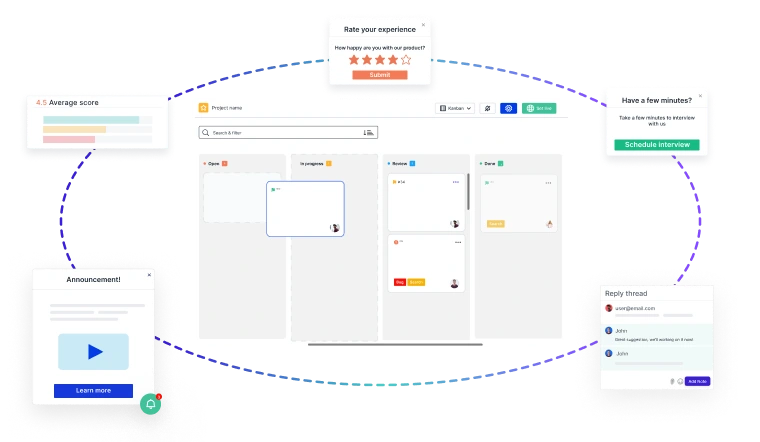
Support tickets, sales calls, in-app comments, surveys and NPS land in one shared view automatically, tagged back to the source the moment they arrive.
- See the pattern across channels, without anyone stitching tools together first.
- Start from a scored opportunity your team can act on the same day.
- Every claim traces back to a real comment, so the roadmap holds up to the follow-up question.
- One platform replaces three to five point tools, with a single data agreement and one security review.
One snippet connects Usersnap to your stack and it is live in minutes. Start free or get a custom trial with our team.
