The product development life cycle (PDLC) is the sequence of stages a product or feature goes through: brainstorming, definition, design, development and testing, and launch. It’s a cycle because what you learn after launch feeds the next round of ideas, so every new feature runs through the stages again. Knowing which stage you’re in tells the team what evidence it needs next.
To see how teams handle these stages in practice, we surveyed over 200 people in product teams about teamwork and how product decisions get made. Here’s the PDLC, stage by stage, with what we learned.
What is the Product Development Life Cycle?
As the name suggests, the product development life cycle is
a process that products go through, from their inception, through definition, design, testing, and launching them.
Each stage is characterized by different activities, requirements, understanding and success of the product, and the problem the company is trying to solve for its customers. While the process can be broken down into many more detailed steps and phases, these five milestones represent most cases well.
Even though it may seem obvious which stage your product is in, understanding the stages is important to prepare for the next one. The best way to do this is through a mixture of research, experience, and, crucially customer feedback.
The PDLC Stages
The product development process is made up of
- Brainstorming
- Definition
- Design
- Development & Testing
- Launch 🚀
For many companies, particularly those in the SaaS industry, staying relevant, and constantly innovating is key to extending the lifetime of their product. While certain features or aspects may be removed, it’s what comes in their place that keeps the company going, or in other words, adaptability. For this to work, we should focus on the last word of the PDLC – cycle. The process does not suddenly stop at the end. Instead, you start from the beginning and go through the circle again for every new feature and decision you want to make.

A similar approach to understanding this process is by looking at the LLBM framework – listen, learn, build, and measure. These steps mirror the cycle that products go through, with an emphasis on listening and learning from users and customers.
Also Read: What is the first step of the perfect customer life cycle?
Your Experiences Throughout the Product Development Life Cycle
We asked people in product teams (product managers, designers and developers) how they work and what matters most when they make product decisions. Over 200 people from startups, scaleups and established companies answered. Here are the results, stage by stage.
1. Brainstorming Ideas
Every product, feature, or service starts with an idea. The source of the idea can be anything from sudden inspiration to a gut feeling, experience, or customer research. The question you should be asking at this point is: what problem are we trying to solve, and how can we do that? And this is where brainstorming comes in. Whatever form it takes, from post-its on a wall to lists or mind maps, you want to find a solution that your team thinks will work for your customer’s needs. Finding out what the competitive landscape looks like is also important at this point to avoid investing resources into an already saturated market.
Our research has shown that for most companies, the starting point for making any product decisions is most often (44%) a mixture of competitive analysis, gut feeling, and user research.
When we dig in a little deeper, we can see that startups place a higher value on user research (31%) when compared to more experienced scaleups (21%). In both cases, a mixture of comprehensive research is still the preferred approach to making an initial decision.
2. Defining the Product
Once the initial brainstorming has concluded, a new set of questions to investigate starts to crystalize:
- Who is the product for?
- What kinds of features will the product need?
- What will the product do?
Answering these questions will require more in-depth research that will try to understand the potential market of the product, and narrow down who it will be targeting, in order to ensure product-market fit.
Why take the time? In CB Insights’ analysis of startup post-mortems, 35% of failed startups said there was no market need for their product. To avoid that, it’s worth checking:
- How much value will the product offer the customer?
- How many people will be willing to pay for it?
- Does it meet their expectations?
We learned from our respondents that, regardless of how mature they are as a company, the primary deciding factor for making product decisions is customer based (35%). What’s more, the more experienced a company is, the more value it places on hearing from its customers.
Focus on the user and all else will follow
Google

At this point, you may be asking yourself how to gather this kind of data. Usersnap has surveys designed to learn about how well your product meets your market’s needs. Find out which features could be useful, which deserve further exploration, and how to keep developing.
3. Getting into Design
Now that you’ve figured out what you want to offer, and who needs it, you have to start thinking about the form your product will take. This process requires creating prototypes, step-by-step wireframes of the product, and finding out what works.
For that to happen, you need to understand what resources you’ll need, from the user interface and design (UI/UX) to the pure technical implementation from your development team.
The focus in this stage is to make it clear what the product or feature should do, and find the easiest, most user-friendly approach to accomplish that task.
The design stage usually requires a lot of collaboration between teams across departments, to get all of the necessary input in.
A large majority – 66% of the product teams we surveyed reported a positive experience of collaborating. Startups were particularly highly focused on product and customer-led growth, with 71% positive collaboration.
4. Testing & Development
At this point, you have the basic structure of your product. Your teams have figured out its basic functionality and how users will interact with it. It’s time to start seeing how it performs in reality. Often, this stage will start with trying to define the MVP or the version of a product with just enough features to be usable by early customers. The purpose of this is to gather feedback from early users, which can be used to further refine the product.
Most often, companies will rely on a variety of processes to validate their product. This starts with designing and making prototypes of the product. Once that’s been produced, they will move on to quality assurance (QA), which starts with alpha testing – technical trials that are done internally in the company to make sure that the product functions correctly.
In beta testing, the product is finally unveiled to your users. This is their first opportunity to try it out and the perfect moment to gather their feedback. Based on it, you can further tweak, improve, and remove any issues that have appeared.
Stay Ahead of the Curve with Usersnap at Every Step

Usersnap is a product evidence platform, and it has a job at every stage. In discovery and testing, in-app widgets and ready-made templates collect bug reports, beta feedback and feature requests, with annotated screenshots and screen recordings that show the problem. With Channels (included from the Growth plan), support conversations and call transcripts land in the same workspace.
In definition, recurring themes become opportunities on the Opportunities Board, scored on value and effort. The Hypothesis Generator and Solution Generator draft what to test and how to approach it from the evidence you collected (included on Professional plans and above, available as add-ons on Starter and Growth). In design, Usersnap turns that evidence into a prototype prompt and hands it to Alloy, which generates the visual concepts. And through the MCP connector, tools like Claude, ChatGPT and Cursor can query the live workspace with each user’s own permissions.
Every output keeps a link to the feedback behind it. In an enterprise with several product teams, a decision made at any stage can be traced back to the customers who asked for it.
5. Ready to Launch 🚀
Finally, the day has come when you’re ready to release your product to the public. For starters, you can use an SMS marketing campaign to send out the message about launching. The marketing team should have prepared all relevant communication and promotional materials by this point and gotten in touch with any press contacts. However, the journey of your product does not end here.
Internally, this is a good moment to think retrospectively. Ask your team what went well throughout the process, and where you can improve.
Once you start to see how your product is performing in the real world, a further stage of analysis begins. There will be new issues to collect, feature requests to fill, and improvements to make. In other words, plenty of customer feedback to collect and analyze.
After launch, Usersnap keeps collecting. Run CSAT and CES surveys triggered by URL, or by events on plans that include it, and track satisfaction and loyalty with NPS. Users can add screenshots and audio or video recordings to show what they experienced. Share the positive feedback with your team, and use the critical feedback to decide what to improve next.
There are so many people that use our product that I can’t and should not assume what they want. We need to learn. We need to understand what life is like in the community to understand what they want, or what they’re gonna want in the future.
Katie Dill, former Head of Design at Lyft
In the end, you’ll find yourself where we started – with an idea for a new solution, feature, or product for your customers, and will use the experience you’ve gained to keep building and improving.
The Value in Evaluating
You may have noticed that a large part of this article has focused on the importance of customer feedback. That’s in no way coincidental. It’s what we’ve been learning from our customers over the years and, most recently, our respondents. Without understanding the voice of your users, the risks of flying blind and without a clear goal grow incredibly, and with it, wasted time and resources.
80% of companies monitor the success of their product through a mixture of qualitative and quantitative data and by monitoring product usage. It’s astounding that 20% have no idea whether they’ve succeeded. Studies show that companies that invest in user experience have lower support costs, tend to grow in market share, and have higher customer retention.
Start a free trial of Usersnap, no credit card needed, and keep every product decision linked to the evidence behind it.
Turn scattered customer signals into decisions you can defend
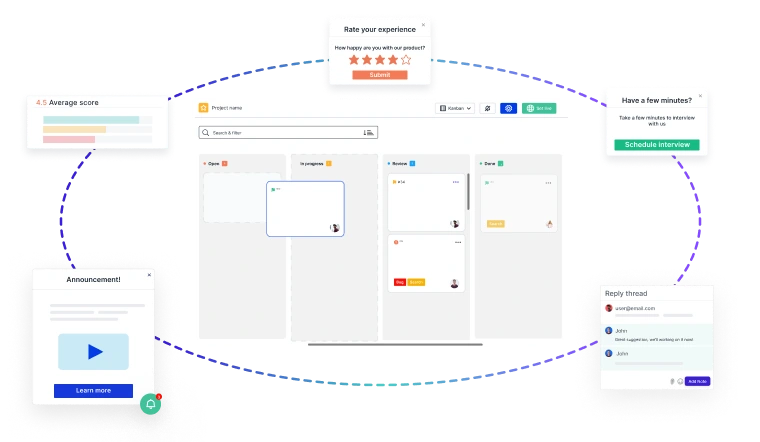
Support tickets, sales calls, in-app comments, surveys and NPS land in one shared view automatically, tagged back to the source the moment they arrive.
- See the pattern across channels, without anyone stitching tools together first.
- Start from a scored opportunity your team can act on the same day.
- Every claim traces back to a real comment, so the roadmap holds up to the follow-up question.
- One platform replaces three to five point tools, with a single data agreement and one security review.
One snippet connects Usersnap to your stack and it is live in minutes. Start free or book a demo with our team.
