Why AI demos feel magical … until reality hits
AI makes it almost effortless to analyze customer feedback.
With a few prompts, some drag-and-drop workflows, and a spreadsheet, you can fly through support tickets, organize interview notes, and pull out themes from surveys in minutes.
In a demo, it feels like magic.
In real planning meetings, it often doesn’t hold up.
As soon as feedback starts shaping your product roadmap or influencing real trade-offs, the cracks begin to show.
In this article, we’ll cover:
- What an AI feedback system really is (beyond shiny outputs)
- Why so many teams try building one themselves
- Where DIY solutions quietly fall apart over time
- How to approach build vs buy as a leader, not just a buyer
TL;DR
- AI makes feedback analysis easy at first
- Decision-level feedback needs structure and accountability
- DIY systems quietly break down over time
- Build vs buy is about owning a system, not comparing features
What Is an AI Feedback System, Really?
It’s not just a chatbot.
It’s not just AI-generated summaries.
And it’s not just a dashboard with grouped comments.
Those are outputs — useful, but not the heart of the system.
A true AI feedback system is decision-grade infrastructure.
At its core, it does a few things extremely well:
- Gathers feedback from multiple sources or channels
- Structures it with consistent categories and/or tags
- Uses AI to detect themes and patterns
- Tracks context and history over time
- Helps you prioritize (not just observe)
- Makes decisions traceable and explainable
AI summaries tell you what people are saying.
Decision-grade systems let you answer:
“Why did we do this — and was it the right decision?”
That’s the difference between interesting insights and real accountability.

Why Do Teams Go DIY First?
Most teams don’t intend to reinvent the wheel.
They build their own system because it seems like the obvious choice:
- The tools are available
- No-code platforms make it easy
- Early results look impressive
A typical DIY setup looks like this:
- Support tickets, interviews, surveys, reviews
- Automations (Zapier, n8n, etc.)
- AI summaries or clustering
- A spreadsheet or a lightweight internal database
At first, it feels great.
You can:
- Summarize a mountain of feedback in minutes
- Spot patterns you’d never notice manually
- Drop impressive charts into meetings
For early exploration, this works.
The problem isn’t that DIY is bad —
it’s assuming it will keep working once decisions start to matter.
Where DIY AI Feedback Systems Break Down
From demo to real-world decisions
Once AI-powered feedback starts influencing actual product decisions, problems creep in — often quietly.
1. Taxonomy and Consistency Drift
Most DIY systems rely on prompts or loosely defined categories.
Over time:
- Categories change
- Prompts get tweaked
- People interpret labels differently
The data still exists — but its meaning is no longer stable enough to trust.
Trend analysis becomes unreliable, and comparisons break down.
2. Decisions Lose Their Trail
Eventually, someone asks:
“Why did we build this?”
DIY systems rarely have a clear answer.
There’s no transparent path from:
feedback → insight → decision
Insights pile up, but decisions feel disconnected.
Leadership sees a black box instead of an audit trail — and trust erodes.
3. Insight Isn’t Prioritization
AI can cluster feedback.
It can’t automatically size opportunities, assign confidence, or weigh trade-offs.
Without explicit prioritization logic:
- Loud feedback beats important feedback
- Recency bias creeps in
- PM judgment becomes invisible
AI starts driving decisions instead of supporting them.
4. Feedback Isn’t One-Way
DIY setups often assume a straight line:
User → Feedback → AI → Insight → Roadmap
Real product work doesn’t look like that.
Teams need to:
- Follow up with users
- Validate assumptions
- Revisit decisions
- Preserve learning over time
When systems don’t support collaboration, visibility, and loops, learning stalls — even if AI output looks good.
5. Maintenance Becomes a Hidden Tax
DIY systems rarely collapse all at once.
Instead, you get slow leaks:
- Prompts need constant tuning
- Model behavior shifts
- Automations fail silently
- Credits run out
- Edge cases multiply
None of this appears on a roadmap — but it consumes time continuously.
6. Single Point of Failure
Usually, one person owns the system — often as a side project.
They become:
- A bottleneck
- The keeper of undocumented knowledge
If priorities change or they leave, the system degrades quickly.
Hiring someone just to maintain it creates a new ROI problem.
7. PM Usability and Accountability Decline
Most DIY systems are built for builders, not PMs.
Product managers struggle to:
- Self-serve insights
- Explain decisions clearly
- Show evidence to stakeholders
When decision logic isn’t visible, accountability weakens.
The Hidden Cost of Building
The real cost of DIY AI feedback isn’t technical.
It shows up as:
- PMs validating data instead of deciding
- Engineers maintaining fragile pipelines
- Meetings spent debating data reliability
- Roadmaps driven by anxiety instead of evidence
What looked free in a demo becomes expensive when real decisions are on the line.
How much time does DIY feedback really cost you?
Pick what’s true in a typical month:
Estimated hidden cost
0 hours / month
Time spent validating feedback instead of making decisions.
Build vs. Buy Is …
The real question isn’t:
“Can we build this?”
It’s:
“Do we want to own decision infrastructure — or focus on making better decisions?”
If you build:
- You own pipelines, prompts, and maintenance
- You manage taxonomy drift
- You manually verify insights
- You become an infrastructure manager
If you buy:
- You rely on stable systems
- You get consistent categories
- You trust decision-grade outputs
- You stay focused on outcomes
This isn’t a tooling decision.
It’s a leadership decision about ownership and accountability.
When Building Makes Sense
Sometimes, building is the right move:
- Dedicated data & ML teams
- Strong internal tooling culture
- Regulatory or proprietary constraints
Even then, teams often rediscover the same challenges:
- Adoption gaps
- Governance drift
- Poor PM usability
- Hard-to-explain decisions
Infrastructure problems don’t disappear — they just become internal.
What a Great AI Feedback System Looks Like
A decision-ready system:
- Centralizes feedback from every source
- Keeps categories stable and rich in metadata
- Uses AI to extract and cluster insights
- Enables prioritization and confidence scoring
- Preserves decision history and context
- Lets PMs self-serve insights
- Keeps decisions explainable and auditable
The goal isn’t more insights.
It’s better decisions — repeatedly.
Final Takeaway
A few things matter most:
- Insight ≠ Decision
- Automation ≠ Accountability
- AI output ≠ PM judgment
DIY AI feedback systems can look great in a demo.
But when decisions matter, you need infrastructure designed for consistency, collaboration, and durability.
For most teams, the smartest move isn’t building more AI —
it’s being intentional about where decisions live and what you choose to maintain.
Accelerate Issue Resolution with Visual Bug Reporting
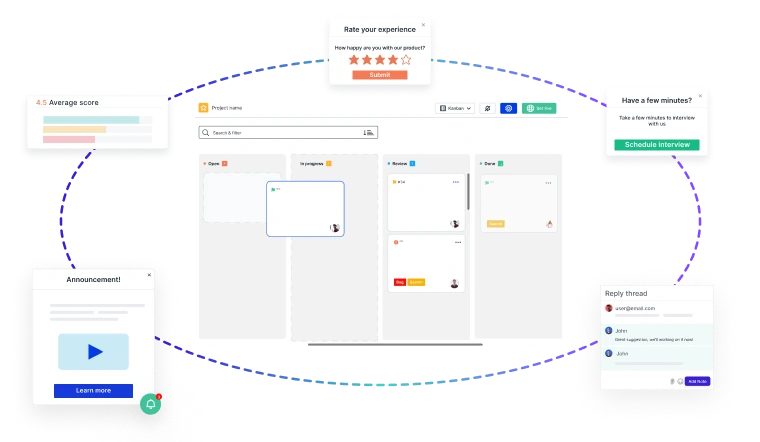
Identify, capture, and resolve issues faster with screen recordings, screenshots, and contextual feedback—seamlessly integrated into your product development lifecycle.
And if you’re ready to try out a visual bug tracking and feedback solution, Usersnap offers a free trial. Sign up today or book a demo with our feedback specialists.
